
History of Unity Lutheran Church, Chicago
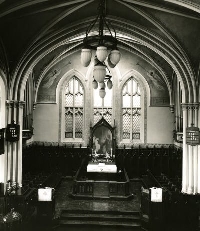
Unity Lutheran Church began meeting in 1905 in a storefront at 1136 W. Argyle Street, after a neighborhood canvass by the General Synod of Northern Illinois found many unchurched people in the Edgewater community. Unity's 43 charter members built a chapel in 1906 at the corner of Balmoral and Magnolia with the help of the synod and First Evangelical Lutheran Church of Altoona, Pennsylvania. The growing congregation built the current church in 1917. The original chapel is now the gym.
On June 22, 1917, Unity was the site of the merger of the General Council of the Lutheran Church and the United Synod in the South into a new church organization, the United Lutheran Church of America.
In 1924, Unity Lutheran Church opened the Lutheran Christian Girls Home, a house for young women coming to Chicago to seek employment. A Lutheran Social Services of Illinois day care center operated at Unity from 1970 to 1996 and today that space is used for after-school tutoring by RefugeeONE (formerly the Interfaith Refugee and Immigration Ministry).
Unity Lutheran Church's ministries extend to the greater Edgewater community through worship, concerts, plays, and partnerships with social organizations such as Care for Real. Our ministry also extends to the worldwide church through the sponsorship of missionaries, beginning with Edith Eykamp in Guntur, India in 1924, and continuing until 2005.
We continue to envision new ministries and opportunities to live our call to be disciples of Jesus Christ.
For more on the building of Unity's 1917 addition and Daniel Burnham trained architect, click on Edgewater Historical Society.
On June 22, 1917, Unity was the site of the merger of the General Council of the Lutheran Church and the United Synod in the South into a new church organization, the United Lutheran Church of America.
In 1924, Unity Lutheran Church opened the Lutheran Christian Girls Home, a house for young women coming to Chicago to seek employment. A Lutheran Social Services of Illinois day care center operated at Unity from 1970 to 1996 and today that space is used for after-school tutoring by RefugeeONE (formerly the Interfaith Refugee and Immigration Ministry).
Unity Lutheran Church's ministries extend to the greater Edgewater community through worship, concerts, plays, and partnerships with social organizations such as Care for Real. Our ministry also extends to the worldwide church through the sponsorship of missionaries, beginning with Edith Eykamp in Guntur, India in 1924, and continuing until 2005.
We continue to envision new ministries and opportunities to live our call to be disciples of Jesus Christ.
For more on the building of Unity's 1917 addition and Daniel Burnham trained architect, click on Edgewater Historical Society.